

Boilers rarely fail at a convenient moment. They fail on the first properly cold morning, during a dinner party, or at 9pm on a Sunday when every office is closed. The radiators go cold, the shower runs lukewarm and then stops being warm at all, and the household starts to wonder how serious this really is.
The good news is that most heating failures follow a handful of familiar patterns, and the first hour matters far more than people expect. What you do in those sixty minutes decides whether you face a quick fix, an unnecessary emergency bill, or a genuine safety problem that needed attention immediately. This guide walks through that hour minute by minute, so that a stressful moment becomes a short list of sensible steps.
Minutes 0 to 5: Rule Out Anything Dangerous First
Before you wonder about the cost or the inconvenience, check the things that could hurt someone. If you smell gas, see a yellow or orange flame where there should be a steady blue one, notice black staining around the boiler, or hear a roaring sound that was not there before, treat it as a gas emergency. Open the windows, turn off the appliance if you can do so safely, avoid switches and naked flames, leave the property, and call the National Gas Emergency Service on 0800 111 999 from outside.
Carbon monoxide deserves its own mention because it gives no smell and no warning. The NHS guidance on carbon monoxide poisoning lists the symptoms to watch for: headaches, dizziness, nausea, breathlessness, tiredness and confusion. If more than one person in the house feels unwell at the same time, particularly when the boiler is running, get everyone outside into fresh air and seek medical help.
If none of those warning signs are present, you can move on with a clear head. A cold house is unpleasant, but it is rarely an emergency in itself.
Minutes 5 to 15: Check the Boring Explanations
A surprising share of callouts end with a simple discovery, so it is worth spending ten minutes on the dull possibilities before you pick up the phone.
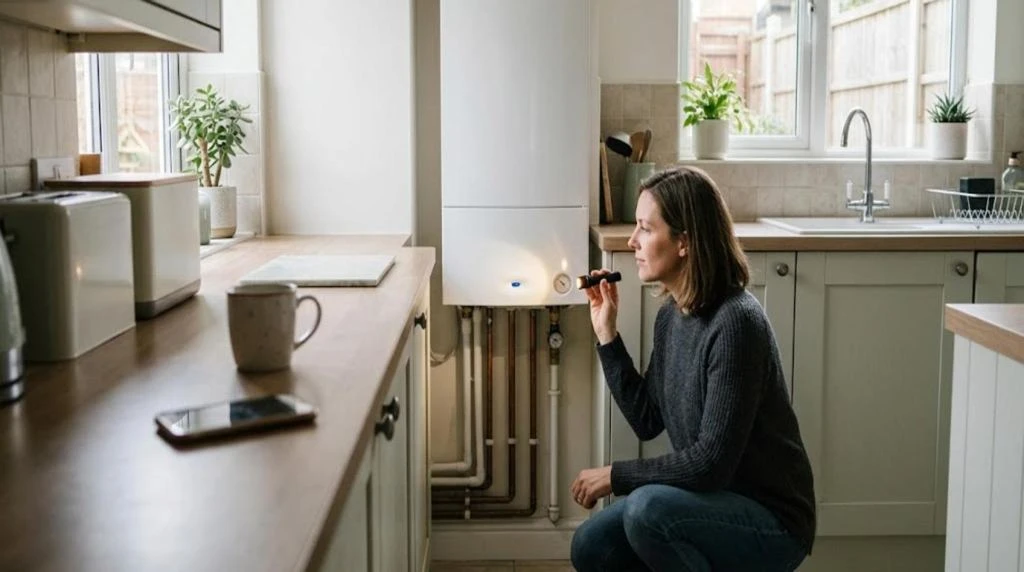
The thermostat and timer. Batteries die, schedules reset after a power cut, and someone may have bumped a dial. Confirm the programmer is on, the thermostat is calling for heat, and the batteries are fresh.
The pressure gauge. Most combination boilers want to sit between roughly 1 and 1.5 bar when cold. If the needle has dropped close to zero, the boiler will often lock itself out to protect the system. Many manufacturers describe a safe way to top the pressure up through the filling loop, and the instruction booklet or a quick look at the model number will tell you how. If the pressure keeps falling again within days, there is a leak somewhere and the filling loop is only masking it.
The power and gas supply. Check that the boiler has electricity, that the fused spur has not tripped, and that other gas appliances such as the hob still work. If the hob is dead too, the issue sits with the supply or the meter, not the boiler.
The condensate pipe. In freezing weather, the plastic pipe carrying acidic condensate outside can freeze solid and shut the boiler down. A kettle of warm, not boiling, water poured along the pipe often restores service within minutes. The telltale sign is a gurgling noise followed by a fault code.
Write down any fault code on the display. It sounds trivial, yet a code and a clear description save a heating engineer a good deal of diagnostic time, which shortens the visit and lowers the bill.
Minutes 15 to 30: Decide Whether This Is a Reset or a Repair
If the boiler offers a reset button, a single reset is reasonable. Repeated resetting is not. A boiler that locks out again within minutes is telling you that something real has failed: an ignition component, a pump, a diverter valve, a sensor, or a blocked heat exchanger. Pressing the button over and over only delays the diagnosis, and in some cases it can stress components further.
This is the point where most people benefit from professional help. Gas appliances are a legal and safety matter in the UK, which is why only a Gas Safe registered engineer should open the casing or touch gas-carrying parts. The Health and Safety Executive’s guidance on gas safety in the home explains why unregistered work is not just a quality concern but a legal one, and it is worth reading before you hire anyone, particularly if you are a landlord.
When you phone, have the following ready: the boiler make and model, the age of the system, the fault code, the pressure reading, and a short note of what you have already tried.
Minutes 30 to 45: Keep the House Livable While You Wait
Repairs rarely happen within the hour, so use this window to protect comfort and prevent secondary damage.
- Close doors and curtains in the rooms you are using, and shut off rooms you are not. Heat stays where you keep it.
- Use safe supplementary heat. Electric heaters are fine when plugged directly into a wall socket and kept away from fabric. Avoid gas hobs, ovens or barbecues for heating. They produce carbon monoxide and moisture, and they cause far more harm than the cold ever would.
- Protect the pipes in a hard freeze. If temperatures are dropping below zero and the heating will be off for a long time, open the loft hatch to let the warmth in and keep a trickle of heat in the coldest areas.
- Plan for hot water. A kettle and a basin cover most needs for a night. If you have an immersion heater, it may restore hot water independently of the boiler.
- Look after vulnerable people. Babies, older relatives and anyone with a health condition need warmth sooner. If a vulnerable person is in the house, say so when you call, because it can change how quickly someone attends.
Minutes 45 to 60: Sort Out the Money Side Calmly
Unexpected repair bills hurt, and desperation is when people agree to prices they would normally question. Ask for a clear callout fee and a labour rate before the visit, and ask what will happen if the part needed is not on the van. A reputable engineer will give you a straight answer and a written quote before starting any work beyond the diagnosis.
If the boiler is old, the visit is also a good moment to ask an honest question: repair or replace? A boiler past fifteen years, with a history of faults and a falling efficiency, can cost more to keep alive than to renew. A good engineer will lay out both options with figures, and will not push you toward the expensive one by default.
If the bill threatens to stretch your finances, you are not without options. Citizens Advice publishes practical guidance on energy problems and on the support that may be available to households struggling to cover heating costs, and it is worth checking before you assume the only route is a loan or a credit card.
Who to Call When It Is Not a Simple Fix
A simple reset and a bit of patience solve a surprising number of cases. When they do not, speed and competence matter more than anything else. In London, one firm that regularly handles exactly this kind of callout is Olia’s Plumbing & Heating, a Gas Safe registered team covering Maida Vale, Notting Hill Gate, Kilburn, Victoria, Pimlico, Westminster, Chelsea, Kensington, North and South Kensington, Shepherd’s Bush, Acton, Hammersmith, Chiswick, Brentford, Kew Gardens and Richmond across Central, West and South West London. If you are in one of those neighbourhoods and would rather have a registered engineer diagnose the fault than keep guessing, visit oliasplumbingandheating.co.uk and click here to book a visit.
After the Repair: Make the Next Failure Less Likely
Once the heating is back, take ten minutes to cut the odds of a repeat. Book an annual service, because most breakdowns announce themselves in advance through small pressure drops, noises and odd smells, and a service picks up those signs before winter does. Bleed radiators each autumn, check the pressure monthly, insulate exposed pipework, and keep a note of the boiler’s make, model and last service date in a place the whole household can find it.
Finally, put the emergency number for your engineer and the gas emergency line somewhere obvious, such as the fridge door or the inside of the airing cupboard. In the middle of a cold night, a household that knows exactly who to call is a household that gets warm again sooner.
A failed boiler feels like a crisis, but treated as a sequence of small, sensible steps, it becomes a manageable evening: safety first, simple checks second, professional help third, and a calmer approach to the bill throughout.What to Do When Your Boiler Stops Working: A Step-by-Step Guide