
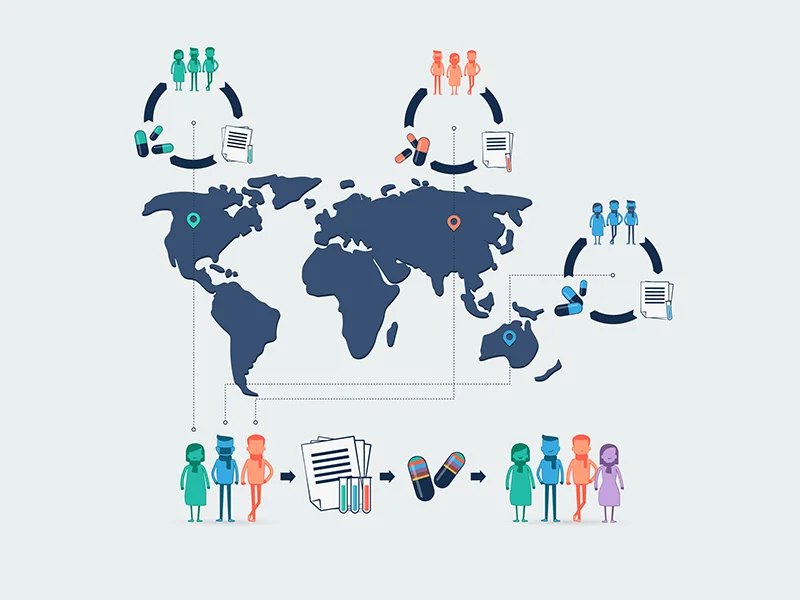
Scientific discovery has never been more advanced. Researchers are exploring everything from quantum phenomena and artificial intelligence to genetic engineering and climate systems. Yet as scientific knowledge expands, so does the challenge of communicating it effectively. Complex datasets, specialized terminology, and abstract concepts can create barriers between scientific communities and the audiences they aim to reach.
Scientific illustrations and animations have become essential tools for overcoming these barriers. By translating intricate ideas into visual narratives, they enable scientists, educators, institutions, and organizations to communicate knowledge with greater clarity, accuracy, and impact.

Why Visual Communication Matters in Science
The human brain processes visual information significantly faster than text. As a result, visual communication has become one of the most effective methods for explaining complex concepts. Scientific illustrations and animations simplify difficult subjects without sacrificing scientific accuracy.
Unlike photographs, which often contain unnecessary details, scientific illustrations are carefully designed to emphasize important structures, relationships, and processes. They guide attention toward key information and help viewers understand concepts that may otherwise seem overwhelming.
Animations extend these capabilities by introducing movement and time. They allow audiences to observe how systems behave, interact, and evolve. This dynamic approach is especially valuable when explaining processes that cannot be directly observed, such as molecular interactions, geological transformations, or astronomical events.
Scientific Illustrations as Tools for Discovery
Scientific illustrations https://scientific-illustrations.com/ are often viewed as communication assets, but they also contribute to scientific discovery itself. During the visualization process, researchers and illustrators frequently identify patterns, relationships, or inconsistencies that may not be immediately apparent in raw data.
Illustrations help scientists organize information into coherent visual structures. Whether depicting ecosystems, biological pathways, engineering systems, or physical models, these visuals provide a framework for analysis and interpretation.
In research publications, illustrations improve readability and comprehension. Figures, diagrams, and graphical summaries allow readers to understand key findings more quickly, increasing the accessibility and impact of scientific work.
The Educational Power of Scientific Animations
Scientific animations have transformed education by making abstract concepts easier to understand. Students often struggle to visualize processes that occur at microscopic, cosmic, or theoretical scales. Animations bridge this gap by showing these processes in action.
For example, animations https://scientific-illustrations.com/portfolio/animation can demonstrate how cells divide, how volcanic eruptions develop, how ecosystems respond to environmental changes, or how planets form within solar systems. By presenting information through motion and storytelling, animations create memorable learning experiences that support long-term retention.
Modern educational platforms increasingly integrate animated content into digital courses, virtual classrooms, and interactive learning modules. This visual approach helps accommodate different learning styles and improves engagement across age groups.
Applications Across Scientific Disciplines
Scientific illustrations and animations are used in virtually every area of science:
Life Sciences
Visualizations reveal complex biological structures and processes, from DNA replication to ecosystem interactions.
Environmental Science
Animations help communicate climate models, biodiversity changes, and sustainability challenges to both experts and the public.
Physics and Engineering
Complex systems, mechanical processes, and theoretical concepts become easier to understand through diagrams and simulations.
Astronomy and Space Exploration
Since many astronomical phenomena cannot be photographed directly, illustrations and animations provide scientifically accurate representations of distant worlds and cosmic events.
Public Science Communication
Museums, documentaries, universities, and research organizations use visual storytelling to engage broader audiences and foster scientific literacy.
Emerging Technologies Reshaping Visualization
The field of scientific visualization continues to evolve rapidly. Three-dimensional modeling tools allow creators to build highly detailed digital representations of natural systems. These models can be explored interactively, providing deeper insights into structure and function.
Virtual reality (VR) and augmented reality (AR) are creating immersive learning experiences that enable users to interact directly with scientific environments. Students can explore the human body, walk through ecosystems, or examine molecular structures in three dimensions.
Artificial intelligence is also transforming content production. AI-assisted visualization tools can process large datasets, generate models, and streamline the creation of scientific illustrations and animations. These innovations are increasing efficiency while expanding creative possibilities.
The Collaboration Between Science and Art
Successful scientific visualization depends on collaboration. Scientists provide expertise, data, and accuracy, while illustrators and animators contribute design principles, storytelling techniques, and visual communication strategies.
This partnership ensures that visual content is not only scientifically correct but also engaging and understandable. Effective visualization requires balancing detail with clarity, allowing audiences to grasp complex information without becoming overwhelmed.
Scientific illustrations and animations have become indispensable components of modern science communication. They help transform data into understanding, research into stories, and discoveries into knowledge that can be shared with the world.
As scientific challenges become more complex and audiences more diverse, the importance of visual communication will continue to grow. Through a combination of scientific rigor, artistic creativity, and technological innovation, scientific illustrations and animations are shaping the future of how humanity learns, explores, and understands the world around it.