
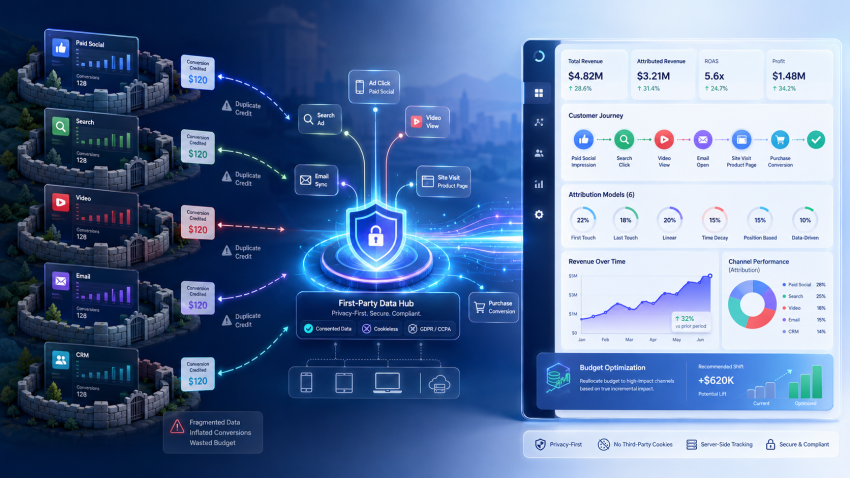
Modern marketing executives face a compounding challenge. Ad costs are rising, user privacy frameworks (like ATT and the deprecation of third-party cookies) have broken traditional tracking, and consumer journeys span more devices and platforms than ever before. In this fragmented landscape, relying on the reporting dashboards of Meta, Google, or TikTok is a recipe for inflated metrics. Each platform operates within its own silo, eagerly claiming credit for the same conversion.
To unlock true efficiency, growth teams must look at their data through an independent lens. Transitioning to an advanced, first-party attribution platform is no longer just a competitive advantage—it is a baseline requirement for survival in a privacy-first digital economy.
The Flaw in Platform-Centric Measurement
When a business scales its digital presence, the limitations of standard tools become painfully obvious. For instance, while setting up a native marketing attribution hubspot workflow helps align sales pipelines with marketing leads, it often fails to capture the complex web of anonymous touchpoints that occur before a form is filled out. CRMs are excellent for managing relationships, but they are not built to parse real-time web traffic, ad impressions, and multi-channel click paths simultaneously.
Without data unity, companies find themselves trapped in a cycle of guesswork. They over-invest in channels that merely appear at the end of the funnel while starving the top-of-funnel campaigns that actually feed the pipeline. Breaking out of this cycle requires moving away from single-touch logic and embracing cross channel attribution tools that evaluate the entire ecosystem objectively.
Real-Time Clarity with ObserviX
ObserviX solves the data fragmentation problem by introducing a privacy-compliant, first-party Pixel that tracks user journeys across all organic and paid channels. Instead of guessing which campaigns are driving revenue, marketing teams can instantly map out the exact sequence of events that leads to a sale.
The platform provides an immediate breakdown of performance using six core attribution frameworks:
- Rule-Based Models (First-Touch, Last-Touch, Linear, Time-Decay, Position-Based): Perfect for baseline comparisons and understanding specific stages of the funnel.
- AI-Driven Attribution: A sophisticated machine learning model that analyzes your unique historical conversion data to dynamically distribute revenue credit based on true statistical impact.
By evaluating channels side-by-side, ObserviX users frequently discover that their actual ROAS looks drastically different from what ad networks report. This allows teams to safely reallocate budget away from underperforming ad sets and scale the exact campaigns driving bottom-line growth.
Turning Attribution Insights into Executive Action
The ultimate goal of marketing analytics is to make confident, data-backed decisions. ObserviX bridges the gap between raw data and strategic execution through its built-in budget optimization engine. Marketers can simulate budget shifts—such as moving capital from underperforming paid social ads into high-intent search or email nurturing—and preview the projected impact on overall revenue.
Furthermore, ObserviX eliminates the stressful “prove it” conversations with the C-suite. The platform replaces messy, manual spreadsheets with clean, executive-ready dashboards. With a single, shareable link, growth leaders can demonstrate absolute alignment between marketing spend and actual business revenue. When your attribution data updates in real time, you move from defensive reporting to strategic leadership.