
Highway Code Rules for Motorways
Motorways are designed to carry large volumes of traffic at high speeds, so drivers need to understand and follow specific rules. Good motorway driving is not simply about travelling at the speed limit. You also need to use the correct lane, maintain a safe following distance, anticipate hazards and understand motorway signs and signals.
Whether you are a newly qualified driver or have been driving for years, understanding the Highway Code rules for motorways can help you make safer decisions and avoid common mistakes.
For more UK driving resources and Highway Code information, visit The Highway Code UK.
Motorway Rules at a Glance
| Situation | Important rule |
|---|---|
| Joining a motorway | Give priority to traffic already on the motorway. |
| Normal driving | Keep to the left unless overtaking. |
| Overtaking | Normally overtake on the right and return left when safe. |
| Speed limits | Never exceed the applicable mandatory speed limit. |
| Red X | Never drive in a lane displaying a red X. |
| Hard shoulder | Use it only when permitted or in an emergency. |
| Stopping | Do not stop unnecessarily on a motorway. |
| Missed exit | Continue to the next exit. Never reverse or turn around. |
Who Can Use a Motorway?
Motorways have restrictions on certain road users and vehicles. Pedestrians, cyclists, horse riders and some slow or restricted vehicles are not permitted to use motorways.
Learner car drivers also have specific restrictions. A provisional car licence holder can drive on a motorway only when accompanied by an approved driving instructor in a car fitted with dual controls and displaying the appropriate learner plates.
This means a learner cannot practise motorway driving with a family member or friend who simply holds a full driving licence.
1. How to Join a Motorway Safely
Joining a motorway requires good observation and speed control. Vehicles already travelling on the motorway have priority, so you must find a safe opportunity to merge rather than expecting other drivers to make room for you.
Use the slip road to build up an appropriate speed and assess the traffic on the motorway. Check your mirrors and blind spots before moving into the lane.
When joining a motorway:
- Give priority to traffic already on the motorway.
- Use the acceleration lane effectively.
- Check your mirrors and blind spots.
- Look for a suitable gap in traffic.
- Match your speed to the traffic flow where appropriate.
- Merge smoothly without forcing another driver to brake.
- Do not use the hard shoulder to join the motorway.
A common mistake is joining at a much lower speed than the motorway traffic. Another mistake is concentrating only on the vehicles immediately beside you instead of looking further ahead and assessing the entire traffic flow.
2. Keep Left Unless Overtaking
One of the most important motorway rules is to keep to the left unless overtaking.
The left-hand lane should normally be your cruising lane. If you overtake a slower vehicle using another lane, return to the left when it is safe and practical to do so.
Remaining in the middle lane when the left lane is clear can be considered poor lane discipline. The fact that you are travelling at the maximum speed limit does not give you a reason to stay in the middle or right-hand lane.
Why lane discipline matters
Good lane discipline makes your intentions easier for other drivers to understand. It also reduces unnecessary lane changes and allows faster traffic to overtake safely.
3. Understanding Motorway Speed Limits
For cars and motorcycles, the national speed limit on a motorway is generally 70 mph unless a different limit is displayed.
However, 70 mph is a maximum rather than a target. You should reduce your speed when traffic, weather, visibility or road conditions make a lower speed safer.
Some motorways use variable speed limits. A speed displayed inside a red circle is a mandatory limit and must not be exceeded.
You may need to slow down because of:
- Heavy traffic.
- Rain or standing water.
- Fog or poor visibility.
- Roadworks.
- Accidents or incidents.
- Sharp bends or changes in road layout.
- Debris or other hazards.
Look well ahead for overhead signs and adjust your speed smoothly rather than waiting until the last moment.
4. What Does a Red X Mean?
A red X above a motorway lane means that the lane is closed. You must not drive in a lane displaying a red X.
The closed lane may contain a broken-down vehicle, road workers, debris or another hazard that you cannot see from your current position.
If you see a red X ahead, move safely into an available lane as soon as it is practical. Do not wait until you reach the obstruction or the end of the closed lane.
Never use a red-X lane to:
- Overtake traffic.
- Skip a queue.
- Reach an exit faster.
- Continue because the lane appears empty.
The absence of an obvious obstruction does not mean that the lane is safe or legal to use.
5. Amber Motorway Warning Signals
Flashing amber motorway signals warn drivers about a hazard ahead. When you see them, reduce your speed and prepare to encounter the hazard.
The hazard could be an accident, congestion, roadworks, debris, stopped traffic or another dangerous situation.
Continue carefully until you have passed the hazard and are satisfied that normal driving conditions have resumed.
6. How to Overtake on a Motorway
Overtaking at motorway speeds requires careful observation and planning. Normally, you should overtake on the right.
Before moving out of your lane, check the interior and exterior mirrors and consider vehicles approaching from behind. Do not move into another lane if a faster vehicle is already approaching closely.
A safe overtaking routine
- Check the road ahead.
- Check your mirrors.
- Check your blind spot where necessary.
- Make sure there is enough space.
- Signal if appropriate.
- Move smoothly into the overtaking lane.
- Pass the slower vehicle safely.
- Return to the left when there is a safe gap.
Avoid staying alongside another vehicle longer than necessary. At motorway speeds, prolonged side-by-side driving can leave you with fewer options if traffic conditions suddenly change.
7. Do Not Undertake
You should not normally overtake another vehicle on the left. Moving into a left-hand lane specifically to pass a slower vehicle is unsafe and can be confusing for other drivers.
There is a difference between deliberate undertaking and traffic moving at different speeds in congested conditions. If queues are moving slowly and one lane happens to move faster than another, you should not repeatedly change lanes simply to gain a small advantage.
Stay patient and maintain a safe position rather than weaving through traffic.
8. Maintain a Safe Following Distance
At motorway speeds, you need sufficient space to react if the vehicle ahead brakes suddenly.
In normal conditions, the Highway Code recommends at least a two-second gap. You should increase this distance in wet weather and other conditions where stopping distances are longer.
Increase your following distance when:
- The road is wet.
- There is ice or snow.
- Visibility is poor.
- Traffic is moving at high speed.
- You are towing a trailer.
- Your vehicle is heavily loaded.
You can check the gap by choosing a fixed object such as a bridge, sign or road marking. When the vehicle ahead passes the object, count at least two seconds before your vehicle reaches it.
9. Changing Lanes on a Motorway
Lane changes should be planned rather than made at the last moment. Before changing lanes, check your mirrors, assess the traffic around you and make sure there is enough space.
Do not assume that indicating automatically gives you priority. A signal tells other road users what you intend to do; you still need to make sure the manoeuvre is safe.
If you need to leave the motorway soon, look for advance signs and move into the correct lane in good time.
Avoid:
- Sudden lane changes.
- Moving across several lanes at once when unnecessary.
- Changing lanes without checking mirrors.
- Cutting in front of faster vehicles.
- Leaving your lane change until the exit is almost reached.
10. Hard Shoulder Rules
The hard shoulder is not normally a lane for ordinary traffic. It is primarily intended for emergencies and certain authorised uses.
On some motorways, the hard shoulder can temporarily or permanently operate as a running lane. In these circumstances, signs and signals will indicate whether it is open to traffic.
Never use the hard shoulder simply to overtake congestion, bypass a queue or reach an exit more quickly.
If a hard shoulder is being used as a running lane and a red X appears above it, you must leave that lane safely.
11. Emergency Areas
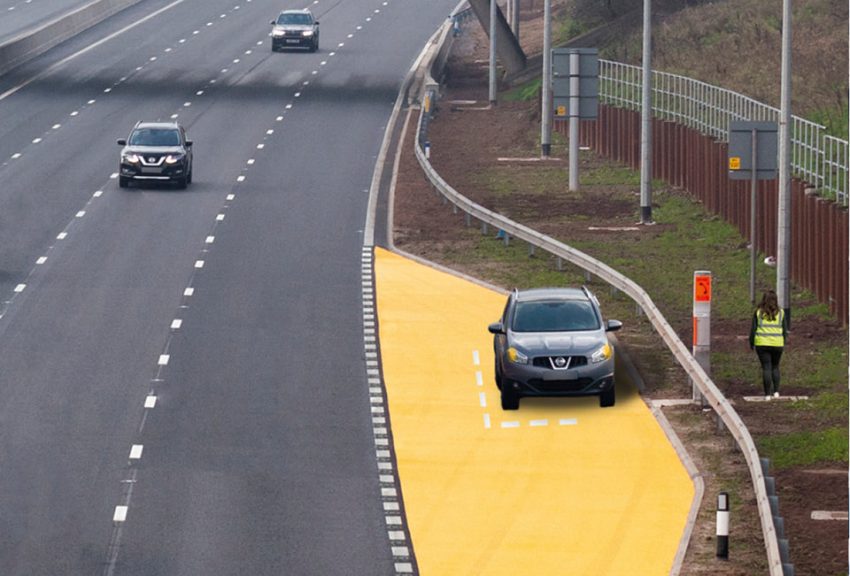
Some motorways have emergency areas where drivers can stop if they experience a problem with their vehicle. These areas are particularly important on motorway sections where there is no conventional hard shoulder.
Emergency areas are for emergencies rather than ordinary stops. If your vehicle develops a serious problem, try to reach an emergency area if you can do so safely.
Follow the instructions provided by motorway signs and contact the appropriate breakdown or emergency service when necessary.
12. What to Do If Your Vehicle Breaks Down
A motorway breakdown can be dangerous because vehicles continue to pass at high speed. Your priority should be to get yourself and your passengers away from moving traffic where it is safe to do so.
If possible, leave the motorway at the next exit or stop at a suitable service area. If this is not possible, move to the left and use an emergency area or hard shoulder where available and permitted.
If you have to stop:
- Switch on your hazard warning lights.
- Try to move as far from moving traffic as safely possible.
- Leave the vehicle using the side furthest from traffic if it is safe.
- Move passengers to a place of relative safety.
- Use an emergency telephone where available.
- Contact your breakdown provider or emergency services as appropriate.
- Follow instructions from police or traffic officers.
If it is not safe to leave the vehicle, remain inside with your seat belt fastened and seek assistance.
13. Never Reverse on a Motorway
If you miss your exit, accept the mistake and continue to the next junction.
Never reverse along a motorway, make a U-turn, cross the central reservation or drive against the direction of traffic to reach a missed exit.
Trying to recover a missed exit can create a serious collision risk. It is far safer to continue and use an alternative route.
14. How to Leave a Motorway
Plan your exit well in advance. Motorway signs usually provide information before the junction, giving you time to select the appropriate lane.
When leaving, move into the correct lane when it is safe, signal appropriately and enter the slip road at a suitable speed.
Do not cross several lanes suddenly because you have realised too late that your exit is approaching.
Once on the slip road, reduce your speed as necessary. Remember that slip roads can contain bends or tighter turns than the motorway itself.
15. Be Careful After Leaving the Motorway
After travelling for a long period at motorway speeds, a lower speed can feel surprisingly slow. This can cause drivers to underestimate their actual speed on the exit road.
Check your speedometer and follow the posted limit. Pay particular attention to sharp bends, roundabouts, junctions and changes in road conditions.
Do not assume that because you have left the motorway, the most demanding part of the journey is over. The road layout can change quickly after an exit.
16. Stopping on a Motorway
You should not stop on a motorway unless there is an emergency or you are instructed to do so.
This includes stopping unnecessarily on the carriageway, hard shoulder, slip road, central reservation or other areas that are not intended for ordinary parking.
If you need a rest, want to make a phone call or need food, use a motorway service area or leave the motorway and find a suitable safe location.
17. Avoid Driving When Tired
Fatigue is a serious risk on motorways because journeys can involve long periods of monotonous driving at high speeds.
If you become tired, do not rely on loud music, opening a window or drinking caffeine as a substitute for proper rest. Stop at a suitable service area and take a break.
Plan long motorway journeys so that you have enough time for regular breaks rather than trying to reach your destination without stopping.
Common Motorway Driving Mistakes
Many motorway incidents are linked to simple errors in observation, planning or lane discipline. The most common mistakes include:
- Staying in the middle lane when the left lane is clear.
- Following another vehicle too closely.
- Joining the motorway without matching the traffic flow.
- Changing lanes without checking mirrors.
- Ignoring blind spots.
- Driving too fast for weather or traffic conditions.
- Ignoring variable speed limits.
- Driving under a red X.
- Using the hard shoulder when it is closed.
- Overtaking on the left deliberately.
- Stopping unnecessarily.
- Trying to reverse after missing an exit.
- Leaving an exit lane change until the last moment.
- Continuing to drive despite serious fatigue.
Motorway Driving Checklist
Before starting a motorway journey, use this quick checklist:
- Plan your route and identify your exits.
- Check your vehicle and fuel or charge level.
- Join the motorway smoothly and safely.
- Keep left unless overtaking.
- Maintain a safe following distance.
- Check mirrors before changing speed or direction.
- Check blind spots when necessary.
- Obey all displayed speed limits.
- Watch overhead signs and road markings.
- React promptly to red X and warning signals.
- Do not use closed lanes or the hard shoulder illegally.
- Plan lane changes early.
- Never reverse or turn around after missing an exit.
- Take regular breaks on long journeys.
Frequently Asked Questions
What is the speed limit on a UK motorway?
For cars and motorcycles, the national speed limit is generally 70 mph on motorways. However, lower mandatory speed limits can be displayed and must be obeyed.
Do I have to stay in the left lane?
As a general rule, yes. You should keep to the left unless overtaking. After overtaking, return to the left when it is safe to do so.
Can I drive at 70 mph in the middle lane?
Travelling at 70 mph does not automatically justify remaining in the middle lane. If the left lane is clear and you are not overtaking, you should normally return to the left lane.
What does a red X mean on a motorway?
A red X means that the lane is closed. You must not drive in that lane and should move safely into an open lane.
Can I use the hard shoulder?
Only when permitted by signs or signals, or when necessary because of an emergency. You must not use it simply to overtake traffic or avoid congestion.
What should I do if I miss my motorway exit?
Continue to the next exit. Never reverse, make a U-turn, cross the central reservation or drive against the direction of traffic.
How much distance should I leave behind another vehicle?
In normal conditions, leave at least a two-second gap. Increase the distance when roads are wet, icy or visibility is poor.
Can learner drivers use motorways?
Yes, but a learner car driver must meet the specific motorway learning requirements, including being accompanied by an approved driving instructor in a suitably equipped vehicle.
Can I stop on a motorway to make a phone call?
No. You should only stop on a motorway in an emergency or when directed to do so. Use a service area for ordinary stops and phone calls.
What should I do if my car breaks down?
Try to reach a safe location such as a motorway service area or emergency area if possible. If you must stop, use hazard lights and get yourself and passengers to a place of relative safety when it is safe to leave the vehicle.
Final Advice for Motorway Drivers
Safe motorway driving is based on anticipation, observation and planning. You should always look well ahead, maintain a safe distance and give yourself enough time to respond to changing traffic conditions.
The most important rules to remember are simple: keep left unless overtaking, obey displayed speed limits, give priority to motorway traffic when joining, maintain a safe following distance, never drive through a red X and never attempt to reverse or turn around after missing an exit.
Motorways can feel intimidating when you are inexperienced, but confidence comes with practice. Concentrate on looking ahead, making smooth decisions and leaving enough time and space for yourself and other road users.
Understanding these Highway Code rules will help you deal with motorway traffic more safely and confidently, whether you are preparing for your first motorway journey or refreshing your knowledge before a long trip.