
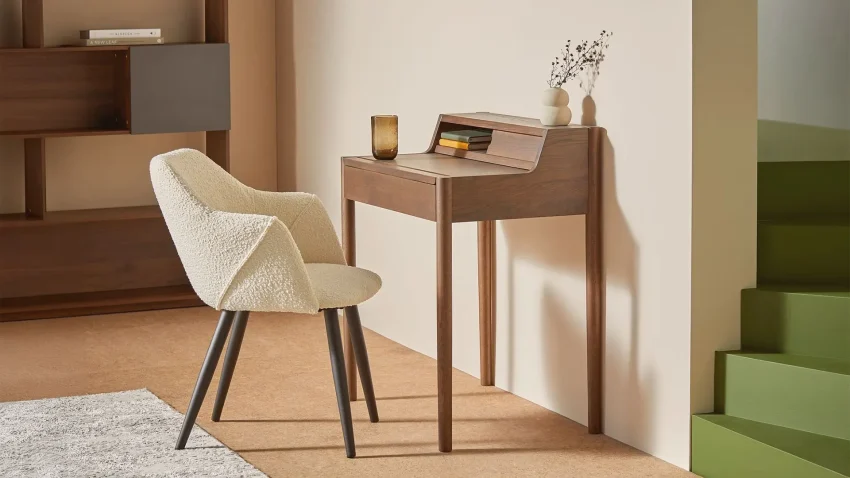
Writing desks vs office desks differ in width, depth, storage capacity, and workload suitability, with writing desks measuring 36 to 48 inches wide and office desks reaching 48 to 72 inches, directly affecting workspace efficiency, storage volume, and technology support requirements.
Furniture selection becomes significantly easier once these measurable differences are understood.
This guide breaks down dimensions, storage structures, construction methods, and real usage scenarios so you can choose the correct desk category without compromise.
How do executive desks compare to writing desks?
Executive desk dimensions measure 60 to 84 inches width and 30 to 36 inches depth, while writing desk dimensions measure 36 to 48 inches width and 20 to 24 inches depth, creating 2 to 3 times greater surface area and storage capacity.
Executive desks exist to support full-time work environments.
A standard 72 x 36 inch executive desk provides 18 square feet of surface area, while a 42 x 22 inch writing desk provides just 6.4 square feet. That difference directly determines whether multiple monitors, documents, and peripherals can be used simultaneously.
Storage capacity shows an even larger gap.
Executive desks typically include 6 to 8 drawers in a box-box-file configuration. Writing desks usually include 0 to 2 shallow drawers, often under 4 inches deep. This means executive desks support structured filing systems, while writing desks support only light stationery storage.
Construction also differs.
Executive desks use panel-based construction with thick sides and pedestal supports, often exceeding 90 to 160 kg in weight. Writing desks use leg-based construction and typically weigh 20 to 35 kg, which allows repositioning but reduces structural load capacity.
According to the Health and Safety Executive guidance on workstation setup, adequate surface area and organisation directly affect productivity and posture. Writing desks do not meet these requirements for prolonged work.
What are the defining characteristics of a writing desk?
Writing desk structure includes a 36 to 48 inch wide surface, 20 to 24 inch depth, 0 to 2 shallow drawers, and four-leg support design, prioritising decorative appearance over storage and technical functionality.
Writing desks follow consistent proportions across styles.
Most models centre around 42 inches width and 22 inches depth, providing approximately 6 to 8 square feet of usable workspace. This size supports a laptop, notebook, and lamp, but prevents expansion into multi-device setups.
Storage remains intentionally minimal.
Traditional designs include either no drawers or one central drawer for stationery. This aligns with historical usage, as documented in the history of writing desks, where furniture supported correspondence rather than storage.
Leg construction defines the aesthetic.
Four independent legs create visual openness, allowing light to pass beneath the desk. This contrasts with office desks that use full side panels, creating visual weight and physical mass.
Material selection often favours solid wood.
Writing desks commonly use hardwoods such as oak, walnut, or mahogany because smaller surface spans reduce warping risk. Office desks frequently use engineered wood cores with veneer surfaces due to larger panel requirements.
Cable management remains absent.
Writing desks rarely include grommets or cable channels. Modern setups require external solutions such as clips or trays, which reduces overall visual cleanliness when compared to office desks designed for integrated wiring.
What does the term “office desk” actually mean?
Office desk definition refers to furniture designed for professional workspace environments, incorporating minimum 48 inch width, integrated storage, cable management, and weight capacity exceeding 150 pounds for sustained daily work.
The term “desk” describes a furniture object.
The term “office” describes a location or usage context.
The phrase “office desk” therefore describes functional requirements rather than a distinct furniture category. In practice, the term signals suitability for professional workloads.
Commercial specifications reinforce this distinction.
Corporate environments require desks that support computers, documents, and accessories simultaneously. This leads to minimum widths of 120 cm and depths of 70 to 80 cm.
Usage patterns define expectations.
Office desks support 6 to 8 hours of continuous use. Writing desks support intermittent use, typically under 2 hours per session.
Terminology differences also vary regionally.
UK retailers often use “home office furniture” or “study desks,” while US retailers apply “office desk” more broadly. This variation creates confusion for buyers comparing products across markets.
When should a writing desk be used instead of an office desk?
Writing desk usage suits light tasks such as journaling, correspondence, and laptop work under 2 hours daily, while office desk usage suits extended work requiring multiple devices, storage systems, and ergonomic support.
Writing desks excel in specific scenarios.
A writing desk works well in bedrooms, living rooms, and hallways where space constraints exist. A 42 inch wide footprint fits comfortably into areas where a 60 inch desk would dominate the room.
Task type determines suitability.
Writing desks support single-device workflows. Activities such as email checking, note-taking, or reading require limited surface area and benefit from uncluttered layouts.
Office desks become necessary with complexity.
Dual monitors typically require at least 110 cm of horizontal space. Printers, files, and accessories increase surface demand beyond 10 square feet, which exceeds writing desk capacity.
Weight limits also matter.
Writing desks typically support 25 to 35 kg. Office desks support 70 to 110 kg, allowing for heavy monitors and equipment without structural stress.
A useful decision rule:
If all equipment fits within a 60 x 60 cm square, a writing desk is sufficient. If equipment exceeds that footprint, an office desk becomes necessary.
How do you choose the right desk based on real usage needs?
Desk selection process requires measuring available space, calculating equipment footprint, assessing daily usage duration, and matching storage requirements to drawer capacity before evaluating aesthetics.
Follow this structured checklist:
- Measure wall space
Confirm at least 90 to 120 cm width for writing desks or 120 to 180 cm for office desks, including 60 cm chair clearance. - Calculate equipment footprint
List all devices and measure total width required. Two monitors typically require 100 to 120 cm alone. - Define daily usage duration
Under 2 hours supports writing desks. Over 4 hours requires office desk ergonomics. - Assess storage needs
If documents exceed 50 sheets or require filing, a writing desk becomes insufficient. - Check leg clearance
Ensure 60 to 70 cm knee space to avoid restricted seating posture. - Plan cable routing
Office desks include integrated systems. Writing desks require external management solutions. - Match room design
Writing desks function as decorative furniture. Office desks function as utility furniture.
For a deeper breakdown of use cases and measurements, refer to this detailed guide on writing desks vs office desks key differences.
Writing desks vs office desks for practical furniture decisions
Writing desks provide 6 to 8 square feet of surface area with minimal storage, while office desks provide 11 to 16 square feet with structured storage systems, making each category suited to entirely different workload requirements.
The distinction is not stylistic.
The distinction is functional and measurable.
Writing desks support focused, minimal tasks in visually sensitive spaces. Office desks support complex, multi-device workflows in dedicated work environments.
Choosing incorrectly creates predictable problems.
A writing desk used for full-time work leads to clutter, cable issues, and limited productivity. An office desk used in a small room creates visual heaviness and spatial imbalance.
The correct choice begins with honest usage assessment.
Measure equipment, define work duration, and calculate space requirements before considering design preferences. This approach prevents costly mistakes and ensures long-term usability.
Key takeaways
Writing desks measure 36 to 48 inches wide with 0 to 2 drawers, while office desks measure 48 to 72 inches wide with 4 to 8 drawers, resulting in up to double the usable workspace and storage capacity.
Writing desks suit light, occasional tasks in decorative settings, while office desks support full-time professional work with multiple devices and structured organisation.
Accurate measurement of equipment and available space provides the most reliable method for selecting the correct desk type.